
Specifications and workshop reference information for the 1978 Husqvarna 250 CR, including engine, chassis, service data and setup details.
Note: Specs are compiled from factory data, manuals and owner feedback. Bikes vary — if yours is different, jump into the forum and share it.
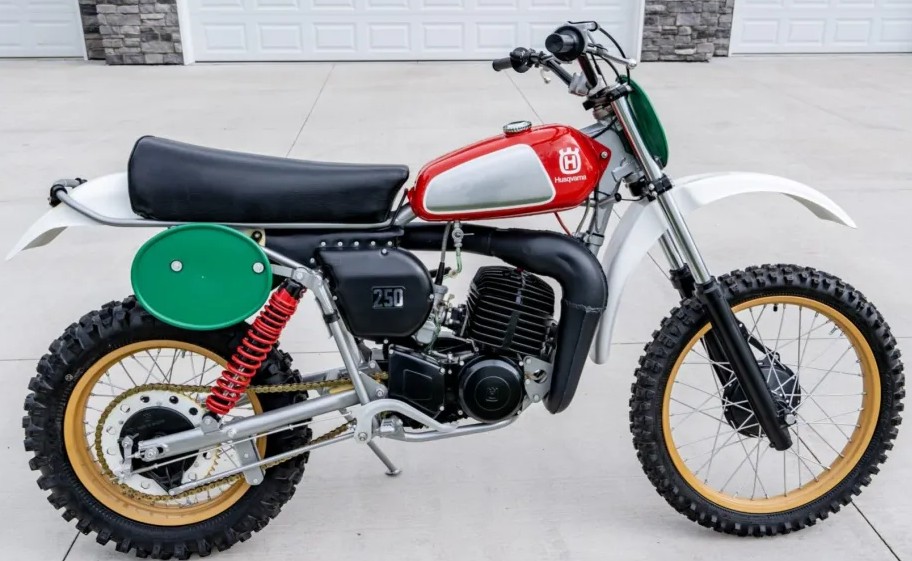
| Engine Type | Air-cooled 2-stroke single-cylinder piston port |
| Displacement | 244 cc |
| Bore × Stroke | 70.0 mm × 64.0 mm |
| Compression Ratio | — |
| Maximum Power | Approx. 34 hp |
| Maximum Torque | — |
| Carburetor | Bing 36 mm | Replacement Options |
| Lubrication | Premix |
| Fuel Mix Ratio | 32:1 | Premix Calculator |
| Ignition | Motoplat magneto |
| Spark Plug | NGK B8ES |
| Spark Plug Gap | 0.5–0.6 mm |
| Transmission Type | 5-speed constant mesh |
| Clutch | Wet multi-plate |
| Primary Reduction | — |
| Final Reduction | — |
| Overall Reduction | — |
| Overall Length | 2170 mm |
| Overall Width | 830 mm |
| Overall Height | 1150 mm |
| Wheelbase | 1460 mm |
| Ground Clearance | 300 mm |
| Fuel Tank Capacity | 9.0 L |
| Bearing Sizes | Bearing Finder |
| Frame Type | Chrome-moly steel double cradle |
| Caster Angle | 28° |
| Trail | — |
| Front Suspension | Telescopic forks | Fork Oil Levels |
| Rear Suspension | Twin shock swingarm |
| Front Suspension Travel | 280 mm |
| Rear Suspension Travel | 250 mm |
| Front Tire | 3.00-21 | Tyre Size Guide |
| Rear Tire | 4.50-18 | Tyre Size Guide |
| Front Brake | Drum |
| Rear Brake | Drum |
The 1978 Husqvarna 250CR arrived at a fascinating point in motocross history. Japanese manufacturers were advancing rapidly with lighter machines, improving suspension and increasingly powerful two-strokes, but Husqvarna still carried enormous credibility from decades of European motocross and off-road competition. The 250CR was pure Swedish thinking: simple, strong and designed to work across a rough motocross track rather than impress riders with unnecessary extras.
At its heart was an air-cooled 250 cc two-stroke single-cylinder engine. Husqvarna had extensive experience extracting usable power from two-strokes, and the 250CR was known more for strong, controllable delivery than an uncontrollable burst of horsepower. That characteristic mattered on late-1970s tracks, where maintaining momentum through ruts and over increasingly rough terrain could be more valuable than outright peak power.
Fuel delivery and ignition condition are particularly important on a surviving machine. Decades of wear, incorrect jetting, intake leaks or a replacement carburettor can make an otherwise healthy Husky difficult to start or unpleasant to ride. Owners recommissioning an old CR can use the VMXOwners carburettor identification and tuning reference when investigating fuelling problems.
The chassis was where Husqvarna's long competition experience really showed. A chrome-moly steel frame combined strength with relatively low weight, while the long-travel suspension reflected the enormous changes motocross had undergone during the 1970s. Tracks were becoming faster and rougher, and suspension travel had increased dramatically compared with machines built only five years earlier.
The twin-shock rear suspension is also one of the defining features of the 1978 CR. Today, shock condition and setup can transform how one of these motorcycles feels. Correct spring preload and rear suspension setup and rider sag are worth checking before assuming an old Husqvarna simply handles poorly. Worn shocks, swingarm bushes or steering bearings can disguise what was originally a very capable chassis.
Power reached the rear wheel through a conventional chain final drive, another area where forty-plus years of use can leave its mark. Sprocket sizes may also have been changed repeatedly during the bike's life as owners adapted it for different tracks or riding conditions. Checking the condition and gearing of the drive chain and sprocket combination is therefore worthwhile during a restoration.
Like every competition two-stroke of the period, the 250CR relied on correctly mixed fuel for lubrication. Modern oils are very different from those available in 1978, and owners often have their preferred ratio, but accurate measurement remains essential. The two-stroke fuel and premix calculator provides a quick way of calculating oil quantity for a chosen fuel volume and ratio.
What makes the 1978 Husqvarna 250CR particularly interesting today is that it represents the classic European motocross motorcycle just as the balance of power was shifting towards Japan. Husqvarna was competing against increasingly sophisticated machinery from Honda, Yamaha, Suzuki and Kawasaki, yet the Swedish factory's reputation for durability, handling and serious competition equipment remained formidable.
More than four decades later, the slim bodywork, alloy tank, twin shocks and unmistakable air-cooled two-stroke engine give the 1978 250CR enormous period character. Restored carefully and set up properly, it is not merely a motorcycle to park in a collection.
It is a reminder of when Husqvarna was still building motocross machines in Sweden to go racing.
Discuss vintage motocross bikes, restorations, tuning and riding.