
Specifications and workshop reference information for the 1983 Honda CR250, including engine, chassis, service data and setup details.
Note: Specs are compiled from factory data, manuals and owner feedback. Bikes vary — if yours is different, jump into the forum and share it.
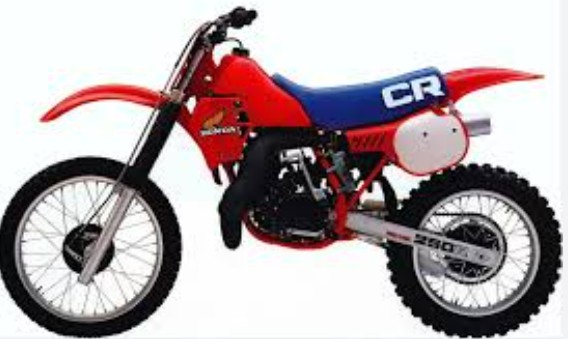
| Engine Type | Single-cylinder, two-stroke, liquid-cooled, reed valve |
| Displacement | 246 cc |
| Bore × Stroke | 66.4 × 72.0 mm |
| Compression Ratio | 8.4:1 |
| Maximum Power | 43 hp @ 8,000 rpm |
| Maximum Torque | 39 Nm @ 7,000 rpm |
| Carburetor | Keihin Piston Valve | Replacement Options |
| Lubrication | Premix |
| Fuel Mix Ratio | 32:1 | Premix Calculator |
| Ignition | CDI |
| Spark Plug | NGK B9EV |
| Spark Plug Gap | 0.6 – 0.7 mm |
| Transmission Type | 5-speed constant mesh |
| Clutch | Wet multi-plate |
| Primary Reduction | 3.250 |
| Final Reduction | 3.500 |
| Overall Length | 2,170 mm |
| Overall Width | 845 mm |
| Overall Height | 1,230 mm |
| Wheelbase | 1,485 mm |
| Ground Clearance | 325 mm |
| Seat Height | 935 mm |
| Fuel Tank Capacity | 7.5 L |
| Dry Weight | 96.5 kg |
| Bearing Sizes | Bearing Finder |
| Frame Type | Steel single cradle |
| Caster Angle | 27.0° |
| Trail | 118 mm |
| Front Suspension | Showa telescopic forks | Fork Oil Levels |
| Rear Suspension | Pro-Link single shock | Rear Suspension Setup |
| Front Suspension Travel | 300 mm |
| Rear Suspension Travel | 280 mm |
| Front Tire | 90/80-21 | Tyre Size Guide |
| Rear Tire | 140/80-18 | Tyre Size Guide |
| Front Brake | Drum |
| Rear Brake | Drum |
| Transmission Oil Capacity | 750 cc |
| Spark Plug | NGK B9EV |
| Spark Plug Gap | 0.6 – 0.7 mm |
| Main Jet | #400 |
| Pilot Jet | #42 |
| Needle | Not Published |
| Float Height | 16 mm |
| Air Screw | 1½ turns out |
| Chain Type | 520 |
| Standard Sprockets | 14T / 49T |
| Starting System | Kick Start |
| 1968 Yamaha DT1 250 |
| 1971 Rickman Montesa 250 |
| 1971 Yamaha DT1E 250 |
The 1983 Honda CR250R arrived during one of the most intense periods of motocross development. Liquid cooling, rising-rate suspension and increasingly sophisticated chassis design were rapidly changing what riders expected from a competition motorcycle. Honda had already introduced many of these ideas on earlier CR models, but by 1983 the pieces were beginning to work together as a much more complete package.
Honda concentrated heavily on reducing weight and lowering the motorcycle’s centre of gravity. Aluminium components were used extensively, while the radiators were positioned low and the redesigned low-mounted fuel tank helped keep mass closer to the centre of the motorcycle. Combined with the narrow seat and slim bodywork, the CR250R allowed the rider to move around easily and change direction quickly.
The liquid-cooled 249cc two-stroke engine also received considerable development. Changes to the cylinder, porting, compression, reed induction and ignition helped produce a broader and more useful spread of power. Correct setup of the Keihin carburettor remained important, but when properly tuned the Honda delivered strong acceleration without requiring the rider to constantly chase a narrow powerband.
That broader delivery was valuable on the track. Riders could carry a taller gear through corners and feed in the clutch when necessary rather than constantly shifting to keep the engine on the pipe. For vintage racers today, that usable engine character remains one of the attractions of a properly sorted 1983 CR250R.
Handling became one of the Honda’s defining strengths. Revised chassis geometry, reduced weight and careful mass centralisation produced a motorcycle that responded rapidly to rider input. The 43 mm Showa front forks offered adjustable compression damping and represented sophisticated suspension equipment for a production motocrosser of the period.
At the rear, Honda continued developing its Pro-Link rear suspension. The Showa shock offered compression and rebound adjustment, giving racers considerably more tuning potential than motocross motorcycles had offered only a few years earlier. For owners restoring one today, worn linkage bushes, bearings and shock components can dramatically change the way the motorcycle handles, so returning the system to proper working condition is well worth the effort.
Braking still belonged to the previous generation. The 1983 CR250R used drum brakes at both ends, although Honda’s front drum was regarded as an effective brake in its day. Disc brakes were rapidly approaching, making the 1983 model an interesting snapshot of motocross caught between two technological eras.
For restorers, originality can now be as challenging as mechanical condition. Many CR250Rs were raced hard, modified and repaired with whatever components were available. Exhausts, bodywork, suspension parts and other model-specific pieces may have been changed several times during a bike’s life, so identifying year-correct parts before starting a restoration can save considerable expense later.
The significance of the 1983 CR250R comes from the complete package rather than one revolutionary component. It combined a strong but manageable engine, lightweight feel, quick handling and increasingly sophisticated suspension.
Honda had spent several seasons developing those ideas. By 1983, they had turned them into one very serious CR250R.
Discuss vintage motocross bikes, restorations, tuning and riding.