
Specifications and workshop reference information for the 1974 Kawasaki KX250, including engine, chassis, service data and setup details.
Note: Specs are compiled from factory data, manuals and owner feedback. Bikes vary — if yours is different, jump into the forum and share it.
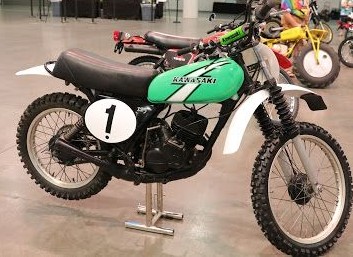
| Engine Type | Single-cylinder, air-cooled, piston port, 2-stroke |
| Displacement | 246 cc |
| Bore × Stroke | 70.0 mm × 64.0 mm |
| Compression Ratio | 6.8:1 |
| Maximum Power | 36 hp @ 7,500 rpm |
| Maximum Torque | 34 Nm @ 6,500 rpm |
| Carburetor | Mikuni VM34SC | Replacement Options |
| Lubrication | Premix |
| Fuel Mix Ratio | 20:1 | Premix Calculator |
| Ignition | Flywheel magneto |
| Spark Plug | NGK B8ES |
| Spark Plug Gap | 0.6 - 0.7 mm |
| Transmission Type | 5-speed constant mesh |
| Clutch | Wet multi-plate |
| Primary Reduction | 2.952 (62/21) |
| Final Reduction | 3.923 (51/13) |
| Overall Reduction | 10.63:1 |
| Overall Length | 2160 mm |
| Overall Width | 880 mm |
| Overall Height | 1180 mm |
| Wheelbase | 1455 mm |
| Ground Clearance | 250 mm |
| Fuel Tank Capacity | 9.5 L |
| Bearing Sizes | Bearing Finder |
| Frame Type | Double cradle steel frame |
| Caster Angle | 29.0° |
| Trail | 120 mm |
| Front Suspension | Telescopic forks | Fork Oil Levels |
| Rear Suspension | Dual shock swingarm |
| Front Suspension Travel | 200 mm |
| Rear Suspension Travel | 100 mm |
| Front Tire | 3.00-21 | Tyre Size Guide |
| Rear Tire | 4.00-18 | Tyre Size Guide |
| Front Brake | Single leading shoe drum |
| Rear Brake | Single leading shoe drum |
The 1974 Kawasaki KX250 belongs to an important period in Kawasaki motocross history. Before the KX name became permanently associated with green race bikes, Kawasaki had spent years developing machines such as the F-series motocross models. The arrival of the KX range signalled a much clearer commitment to purpose-built competition machinery, and the 250 quickly became an important part of that new direction.
By modern standards the 1974 KX250 was remarkably simple: an air-cooled two-stroke single, conventional telescopic forks, twin rear shocks and drum brakes. In the mid-1970s, however, motocross development was moving incredibly quickly. Power was increasing, suspension travel was growing and manufacturers were learning that a competitive engine meant little if the chassis could not put that performance onto a rough track.
The KX250's two-stroke engine delivered the light weight and rapid throttle response expected from a serious 250cc motocrosser. Fuel was supplied through a conventional slide carburettor, and surviving machines have often been re-jetted, modified or fitted with replacement units during decades of racing and restoration. Owners trying to identify or replace a worn unit can use the vintage motorcycle carburettor replacement guide when researching suitable options.
Like virtually every competition two-stroke of its era, the KX250 relied on premixed fuel rather than an oil-injection system. Getting the fuel-to-oil ratio right remains important on a restored or regularly ridden machine. Original specifications and engine condition should always guide the choice of ratio, while the 2-stroke premix oil calculator makes calculating the actual amount of oil required for a chosen mixture straightforward.
Suspension is another area where a 1974 KX250 can feel very different today from when it was new. The twin-shock rear end represents the traditional layout that would soon face competition from increasingly sophisticated long-travel systems. After more than fifty years, worn swingarm components, tired shock springs and incorrect preload can have a major effect on handling. Checking vintage motorcycle rear suspension setup and sag is a useful starting point when bringing an old race bike back into usable condition.
The conventional front forks deserve the same attention. Fork seals, springs, internal wear and decades of incorrect or contaminated oil can dramatically alter the way an early KX steers and absorbs bumps. The vintage motorcycle fork oil levels and setup guide provides useful reference information when servicing period suspension.
Today, finding an untouched 1974 KX250 is difficult. These were competition motorcycles, and racers modified whatever might make them faster or simply keep them running. Handlebars, guards, shocks, exhaust systems, wheels and engine components were routinely replaced.
That racing history is exactly what makes the 1974 Kawasaki KX250 interesting. It comes from the formative years of the KX dynasty, before long-travel suspension, disc brakes and water cooling transformed motocross machinery. More than half a century later, the KX name remains one of Kawasaki’s most recognisable competition badges — and bikes like the 1974 KX250 helped establish it.
Discuss vintage motocross bikes, restorations, tuning and riding.