
Specifications and workshop reference information for the 1983 Kawasaki KX500, including engine, chassis, service data and setup details.
Note: Specs are compiled from factory data, manuals and owner feedback. Bikes vary — if yours is different, jump into the forum and share it.
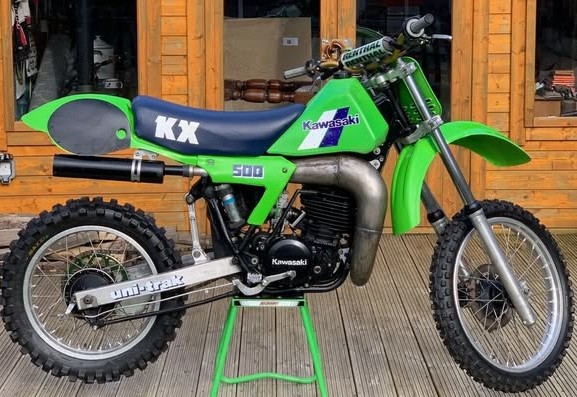
| Engine Type | Air-cooled 2-stroke single, reed valve |
| Displacement | 499 cc |
| Bore × Stroke | 86 × 86 mm |
| Compression Ratio | 7.0:1 |
| Maximum Power | 65 hp / 47.4 kW |
| Maximum Torque | Not confirmed |
| Carburetor | 38 mm Mikuni | Replacement Options |
| Lubrication | Premix |
| Fuel Mix Ratio | Not confirmed |
| Ignition | CDI |
| Spark Plug | Not confirmed |
| Spark Plug Gap | Not confirmed |
| Transmission Type | 5-speed |
| Clutch | Wet plate |
| Primary Reduction | Not confirmed |
| Final Reduction | Chain |
| Overall Reduction | Not confirmed |
| Overall Length | Not confirmed |
| Overall Width | Not confirmed |
| Overall Height | Not confirmed |
| Wheelbase | 1514 mm / 59.6 in |
| Ground Clearance | 325 mm / 12.8 in |
| Fuel Tank Capacity | 9.0 L / 2.4 US gal |
| Bearing Sizes | Bearing Finder |
| Frame Type | Chrome-moly steel tubing, aluminum rear subframe |
| Caster Angle | Not confirmed |
| Trail | 122 mm / 4.8 in |
| Front Suspension | 43 mm leading-axle air-assisted forks, adjustable compression damping | Fork Oil Levels |
| Rear Suspension | Uni-Trak |
| Front Suspension Travel | 300 mm / 11.8 in |
| Rear Suspension Travel | 304.8 mm / 12.0 in |
| Front Tire | 3.00-21 | Tyre Size Guide |
| Rear Tire | 5.10-18 | Tyre Size Guide |
| Front Brake | Single 220 mm disc |
| Rear Brake | Drum |
The 1983 Kawasaki KX500 marked the beginning of one of motocross’s most famous big-bore bloodlines. The KX500 name would eventually become synonymous with brutal speed, huge two-stroke power and open-class racing, but the first version was a very different motorcycle from the liquid-cooled machines that later built the legend.
At its heart was a massive air-cooled two-stroke single. Kawasaki was competing in an era when the open class was still a major battleground, and manufacturers were searching for ways to combine enormous engine performance with rapidly improving suspension and chassis technology. The KX500 delivered exactly the sort of power expected from the class: strong, aggressive and capable of testing both rear-wheel traction and the rider hanging onto the handlebars.
Feeding such a large two-stroke required careful carburation. Correct setup of the large-bore carburettor remains particularly important on a surviving KX500. Jetting that is too rich can make an old two-stroke run poorly, while an excessively lean mixture can become a much more serious problem on a hard-working air-cooled engine.
The chassis reflected how quickly motocross design had changed by the early 1980s. Long-travel suspension was now expected, and Kawasaki used its Uni-Trak rising-rate single-shock system at the rear. Maintaining the Uni-Trak rear suspension and linkage is especially important on a vintage machine. Decades of wear in linkage bearings, bushes and the shock can completely alter the handling and ride height of a motorcycle that may otherwise appear mechanically sound.
Up front, the long-travel telescopic front forks had the difficult job of keeping the big Kawasaki under control across braking bumps, jumps and rough open-class tracks. For vintage racers today, fresh seals, correct oil levels and properly functioning damping can make a remarkable difference compared with simply riding an unrestored fork because “that’s how old bikes handled.”
The engine’s enormous torque also placed considerable demands on the final drive. The condition and adjustment of the drive chain and sprockets deserve close attention on any early KX500 intended to be ridden. Worn components that might survive gentle use on a smaller motorcycle are dealing with a very different proposition when a big-bore two-stroke is repeatedly driven hard.
What makes the 1983 KX500 particularly interesting today is that it represents the starting point rather than the finished product. Kawasaki continued developing the model aggressively, moving to liquid cooling and refining the engine, suspension and chassis as the decade progressed. Later KX500s became faster, more sophisticated and ultimately more famous.
That does not diminish the importance of the original. If anything, it gives the 1983 model a character of its own. It belongs to the brief period when enormous air-cooled engines were being combined with the new generation of long-travel, single-shock motocross chassis.
The later KX500 would become a legend.
The 1983 model was where Kawasaki started building it.
Discuss vintage motocross bikes, restorations, tuning and riding.